 Amsterdam Windmill Tours
The Best Zaanse Schans Photo Spots, and the Hour to Shoot Each One
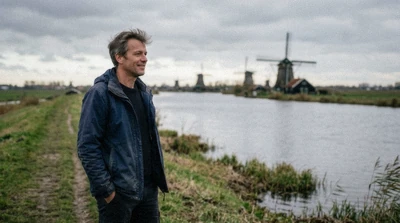
The best Zaanse Schans photo spots come down to five places, and four of them are free. The Julianabrug gives you the panorama, the far bank gives you reflections with nobody in the frame, De Kat's platform gives you the row of mills from above, and the dike path gives you the leading line every postcard uses. What decides the picture is not the lens, it is being there between nine and half past ten. The guided windmill trips from Amsterdam arrive later than that, which is the one thing worth knowing before you book one.
Quick answer
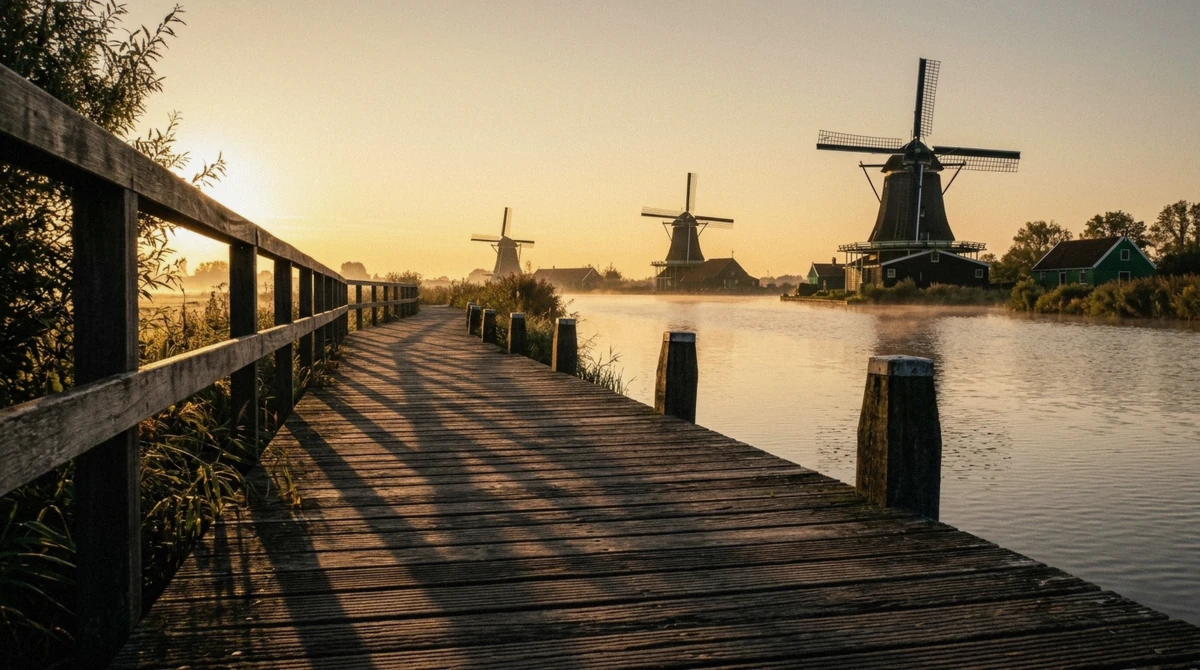
Shoot the Julianabrug panorama on the way in, the reflections from the far bank of the Zaan just after sunrise, the mill row from De Kat's outside platform for the elevated shot, and the dike path in the last hour before sunset. Come between the 9:00 opening and 10:30 or after 16:30, when the coaches have gone. Only the platform costs anything, at €7.50 to enter the mill.
Key takeaways
- Julianabrug: the classic wide panorama, free, best in morning light
- Far bank of the Zaan: reflections and no people, first light or late evening
- De Kat's platform: the elevated row of mills, €7.50 with mill entry, open 9:00 to 16:30
- Dike path: the leading-line shot every postcard uses, best an hour before sunset
- Golden hour beats blue hour here, because the mills read as silhouettes after dark
- No drones: the site sits under Schiphol's controlled airspace
The Five Spots, in Shooting Order
1. The Julianabrug, on the Walk In
Coming from Zaandijk Zaanse Schans station you cross the Zaan on a white steel footbridge, and halfway across the whole village lines up on the far bank: mills, green timber houses, red roofs, reeds.
It is the widest view you will get without a boat, and it costs a train ticket. Shoot it in the morning with the sun behind you, use the bridge rail as a foreground if you want depth, and take it before you walk on, because the light will have moved by the time you come back.
| Spot | Best light | Cost | What you get |
|---|---|---|---|
| Julianabrug | Morning, 9:00 to 10:30 | Free | The full village panorama |
| Far bank of the Zaan | First light or evening | Free | Reflections, no people |
| De Kat platform | Any time it is open | €7.50 | Elevated row of mills |
| Dike path | Last hour before sunset | Free | Leading lines, low sun |
| The far end, past the last mill | Any time | Free | Wide polder skies, empty frames |
2. The Far Bank, for the Reflections
Walk past the last mill and keep going along the water. The bank opposite the village is where the reflection shots come from, and almost nobody makes the extra ten minutes' walk.
Still water is the whole game here, so this is a first-light or late-evening spot. On a calm morning the mills double perfectly in the Zaan, and there is not a coach in sight because the car park is behind you and out of frame.
3. De Kat's Platform, for the Elevated Shot
The only elevated position on the site that is open to the public. Pay the €7.50 mill entry, climb the steep stairs, and step out onto the wooden gallery that circles the mill.
From up there the other mills line up along the river with the polder behind them, and you shoot down onto the green roofs instead of across at them. The stairs are narrow, so a big camera bag is a liability; take one body and one lens. The mill opens 9:00 to 16:30, which makes this the earliest good light of the day.
4. The Dike Path, for the Leading Line
The gravel path along the river with the mills receding beside it is the shot everyone knows, and it works because the path pulls the eye straight into the frame.
The hour before sunset is the best version: low sun across the water, long shadows on the boards, and the coaches gone. In June that means shooting at nine in the evening, well after the mills close, which is fine because this one is exterior only.
5. Past the Last Mill, for the Sky
Keep walking until the buildings stop. What is left is polder: flat green fields, straight water, and about eighty percent sky.
This is where you photograph weather rather than windmills, with one mill small in the frame for scale. In autumn, when the clouds stack up over the Zaan, it is the most Dutch photograph available anywhere near Amsterdam.
Practical Notes for Photographers
Light, Season and Wind
Golden hour beats blue hour here. The mills are dark tarred timber, so after sunset they read as flat silhouettes and the green houses lose all their colour.
Wind decides whether the sails move, and moving sails are the difference between a photograph of a building and a photograph of a machine. If you want motion blur in the sails, a shutter around 1/15 second on a tripod is the honest range; the sails turn slowly.
Season changes the frame more than most people expect. Summer gives you long evenings but haze and crowds; autumn gives you cloud structure; winter gives you low sun all day and an empty site, at the cost of two mills being shut.
| Season | Best about it | Watch out for |
|---|---|---|
| Spring | Fresh green, blossom, everything open | Tulip-season crowds from mid-April |
| Summer | Long evenings, light until 21:30 | Haze, peak crowds, no shade |
| Autumn | Cloud structure and mist on the water | Shorter days, mills close at 16:30 |
| Winter | Low sun all day, empty paths, best reflections | Two mills shut, dark by 16:30 |
Rules, Drones and People
No drones. The site sits under Schiphol's controlled airspace and the village is private property with its own house rules, so this is not a grey area.
The millers work in these buildings while you photograph them. Ask before shooting someone at close range, keep off the working floors, and remember that tripods on the narrow mill stairs are a genuine hazard rather than an inconvenience.
On the paths, the crowd is the problem to solve, and the solution is time of day rather than post-processing.
- One body, one lens if you plan to climb De Kat
- Wide for the Julianabrug, short telephoto for compressing the mill row
- Tripod for the reflections and for sail blur, not on the mill stairs
- A cloth: the wind carries spray off the water on rough days
- Arrive at 9:00 or stay past 16:30, whichever suits your light
If You Are Coming on a Tour
Coach trips give you roughly 90 minutes to two hours on site, usually between 10:30 and 15:30, which is the worst light and the biggest crowds of the day.
You can still get the shots: skip the demonstrations, walk straight past the last mill to the far bank, and use the crowd-free stretch. But if photographs are the reason for the trip, take the train instead and choose your own hour. Every route and fare is set out separately, and the best months and hours go into the timing in more detail.
Two Shots Worth Planning a Trip Around
The first is fog. From late September through February the Zaan produces morning mist that sits at mill height and burns off by ten, and the mills come out of it in layers. It is the best photograph available here and it cannot be arranged, only waited for. Watch the forecast for a still, clear, cold night followed by a calm morning.
The second is a working sawmill from inside. Het Jonge Schaap saws with the doors open and the light comes in behind the frame saw, which gives you backlit dust and moving blades in one frame. It needs a fast lens or a high ISO, and it is the only interior here that genuinely rewards a second visit.
Both of these are morning propositions. Both are ruled out by a coach schedule that puts you on site at eleven, which is the practical argument for the train.
Gear That Actually Helps
Nothing exotic. The site is compact, flat and photographable on a phone.
- Wide, around 24mm, for the Julianabrug and the interiors
- Short telephoto, 70 to 135mm, to compress the mill row from the far bank
- Polariser for the reflections, which are the point of the far bank
- A small tripod for mist and sail blur; leave it off the mill stairs
- Spare battery in winter: cold and wind eat them on an exposed dike
Keeping People Out of the Frame
By eleven the dike path has a continuous line of visitors on it, and there is no angle that hides them. Three things work.
Go early, which solves it completely between nine and half past ten. Go long, using a short telephoto from the far bank so the buildings compress and the path drops out of frame. Or go late, after the mills close at 16:30, when the site empties within twenty minutes and the light is at its best anyway.
What does not work is waiting for a gap. On a summer afternoon there is no gap, and standing there hoping for one costs you the light.
Where the Five Spots Are
Four of them cost nothing. The platform needs a mill ticket.
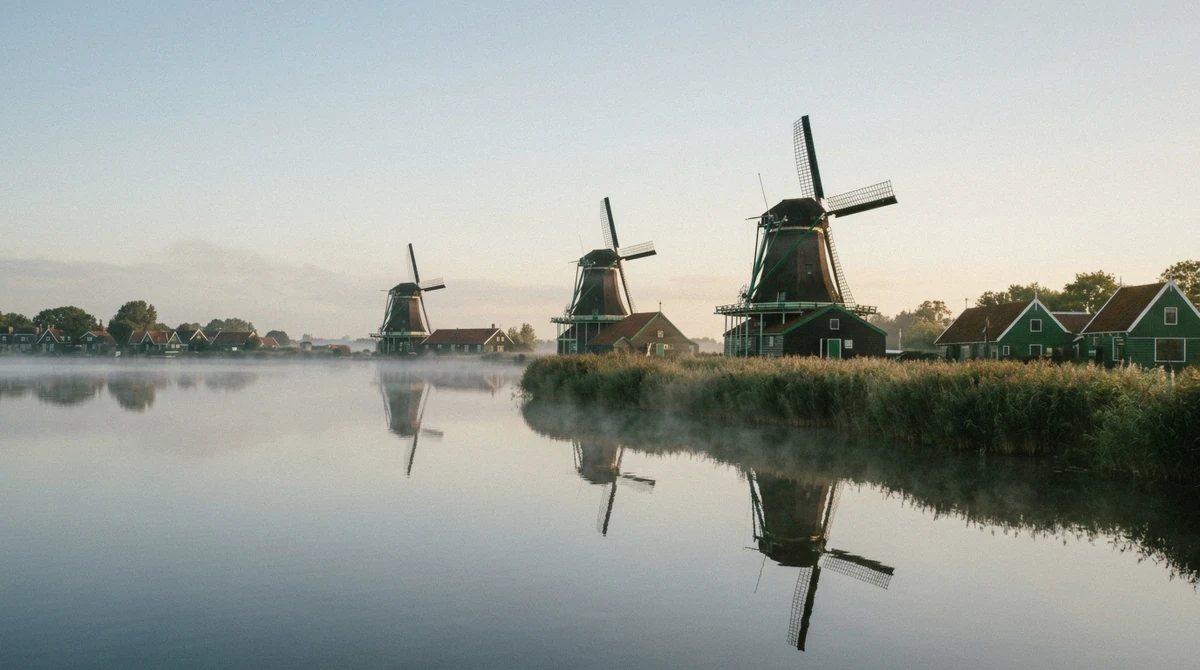
Quarter past seven in September, from the far bank. Still water, no people, and the whole village doubled.
Questions From Photographers
Where is the best photo spot at Zaanse Schans?
The Julianabrug on the walk in from Zaandijk station, for the full village panorama, and it costs nothing. For reflections without people, walk past the last mill to the far bank of the Zaan; for the elevated shot, pay €7.50 and climb onto De Kat's platform.
What time of day is best for photographs?
Between the 9:00 opening and 10:30, before the coaches arrive, or after 16:30 when they leave. Golden hour works better than blue hour here, because the dark tarred mills flatten into silhouettes once the sun is down.
Can you fly a drone at Zaanse Schans?
No. The site sits under Schiphol's controlled airspace and the village has its own house rules against it. There is no permit process worth pursuing for a casual visit.
Do you have to pay to photograph the windmills?
Not from outside. The village, the dike path, the bridge and the far bank are all free. The only paid viewpoint is the gallery on De Kat, which comes with the €7.50 mill entry.
Which season photographs best at Zaanse Schans?
Autumn for cloud structure and mist, winter for low sun and empty paths, spring for fresh colour. Summer gives the longest evenings but the most haze and the biggest crowds, and two mills are shut from November through March.
Will the sails be turning?
Only if the wind suits. A dead calm stops everything, and a gale makes the miller furl the sails for safety. Check the forecast rather than the calendar if moving sails matter to your shot.
Can you photograph inside the mills?
Yes, and the interiors are worth it: grinding stones, timber gearing and shafts turning in low window light. Bring one lens rather than a bag, because the stairs are steep and narrow, and keep tripods off them.